joey cao
Becoming a Parent Movement exists to bring consciousness to the decision of becoming a parent — a moment where childhood trauma can still be prevented, rather than inherited and repaired later.
Most conversations about parenting begin after a child arrives.
We focus on healing, repairing, and understanding what shaped us — often years later, when patterns are already in motion.
This work matters deeply. It has helped many people make sense of their experiences and find compassion for themselves and their parents.
Becoming a Parent Movement begins earlier — at the moment a decision is still forming.
Not because what comes later is wrong, but because timing changes what’s possible.
Long before we become parents, we’ve already been shaped by relationships.
We learned what closeness feels like.
How conflict is handled.
What safety sounds like — or doesn’t, when we are children.
Much of this learning happened quietly, without conscious choice.
Not because anyone intended harm, but because patterns are passed on through everyday moments — tone, presence, and emotional response.
Once a child arrives, these patterns are already in motion.
They don’t begin then — they continue.
Before that moment, there is still space to notice what we carry.
To bring awareness to what might otherwise be inherited without question.
Awareness doesn’t guarantee perfection.
But it changes what gets passed on.
Becoming a parent is often treated as a moment —
a decision, a pregnancy, a birth.
This movement understands becoming differently.
Becoming is not a switch that flips when a child arrives.
It is a process that begins earlier — when a decision is still open, and reflection is still possible.
It is a period of preparation that is less about learning what to do, and more about noticing who we are.
Becoming means slowing down long enough to ask what we are carrying — emotionally, relationally, unconsciously — before those patterns have someone else to land on.
It means taking responsibility not just for the kind of parent we hope to be, but for the inner world we bring into the relationship.
Not to achieve perfection.
Not to eliminate all struggle.
But to reduce what gets passed on simply because it was never examined.
Becoming, in this sense, is an act of care — for a future child, and for ourselves, too.
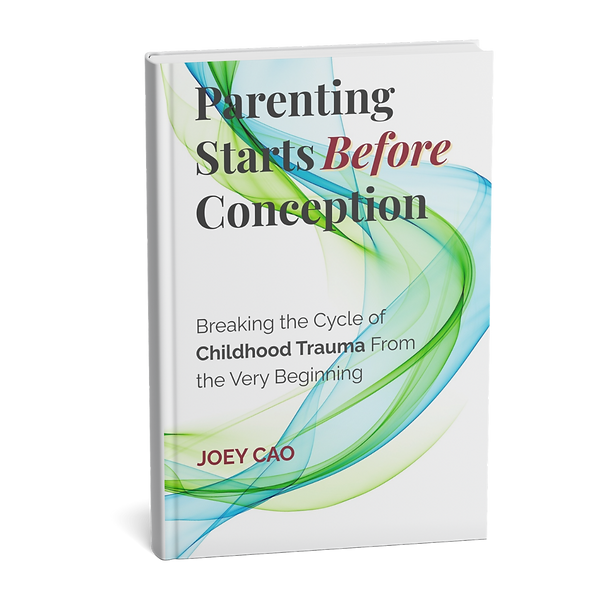
This perspective is explored more fully in my book, Parenting Starts Before Conception — written for those who want to reflect before a child arrives, rather than make sense of things only after something needs repair.
The movement exists to hold this space for reflection — without pressure, without judgment, and without the assumption that everyone must arrive at the same decision.
Becoming is not about moving faster.
It is about becoming more conscious of what we are choosing — and what we are choosing to carry forward.
This movement is not about blaming parents.
Most people do the best they can with what they were given.
It is not about achieving perfection, emotional purity, or getting everything right before a child arrives.
It is not about fear — of trauma, of mistakes, or of doing harm.
And it is not about telling anyone when or whether they should become a parent.
Becoming a Parent Movement does not assume that reflection guarantees a particular outcome.
Some people may choose to move forward with greater clarity.
Others may realize they need more time.
Some may decide that parenthood is not the right path for them.
All of these are valid.
This movement does not offer formulas, checklists, or certainty.
It does not promise that conscious parents raise untroubled children.
It simply acknowledges that awareness changes what is carried forward — and that timing matters when it comes to what can be seen, chosen, and held with care.

Becoming a Parent Movement exists beyond this page.
It lives as an ongoing, quiet conversation for those who are reflecting on parenthood before making the decision — often privately, often without clear language, and often outside the timelines or expectations around them.
The movement is not organized around urgency or consensus.
It exists to hold space for reflection, responsibility, and conscious choice — wherever that reflection happens.
There is no conclusion to arrive at here.
Only questions that deserve time, and decisions that matter enough to be made consciously.
You don’t need to agree with everything on this page.
You don’t need to know what you’ll decide next.
If this perspective stays with you, let it.
If it doesn’t, you’re free to leave it behind.
Either way, slowing down at the right moment can change what gets carried forward.